CATEGORIES:
AUTHORS:
ABOUT THE H&F AUDIO LIBRARY
The Hail & Fire Audio Library is a FREE online Christian resource for MP3 Audio Books. Listen online using the H&F Audio Player or download the MP3 audio files to your computer, iPod or portable player.

H&F's FREE ONLINE LIBRARY
Hail & Fire's Online Library is a FREE book resource for Christian, Puritan, Reformed and Protestant sermons and exhortative works; Protestant and Catholic polemical and apologetical works; bibles, histories, martyrologies, and eschatological works.
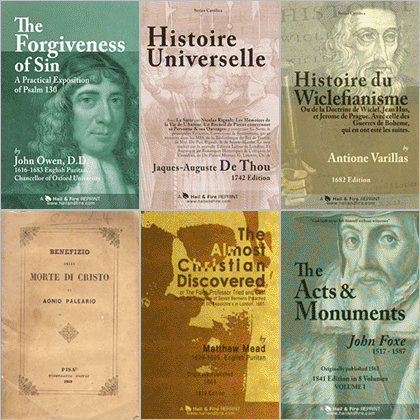
H&F PAPERBACKS
Purchase Hail & Fire paperbacks through our eBookstore or from major online resellers!
"By manifestation of the truth commending ourselves to every man's conscience in the sight of God."
2 Corinthians 3:2
| |
| |

|
|
|

AUDIO LIBRARY: MP3 AUDIOBOOKS
|
|
Player or download the MP3 audio files to your computer, iPod or portable player. By using the Hail & Fire Library you agree to the following copyright notice. |
H&F Has a New Audio Voice!
Play audio sample » |
 The Hail & Fire Audio Library is a FREE online Christian resource for MP3 Audio Books. Listen online using the H&F Audio

Hugh Binning was a Scottish Covenanting preacher, ordained minister of Govan, near Glasgow, in 1650. He was only twenty-six years old when he died in 1653.
Quotations:
"Humility levels men to a holy subjection and submission to another, without the confusion of their different degrees and stations. It teaches men to give that respect and regard to even one that is due to his place or worth ... Eph. v. 21, 'Submit yourselves one to another in the fear of God.' 1 Pet 5:5, 'All of you be subject one to another, and be clothed with humility.'"
Available MP3 Audio Books:
 The Works of Hugh Binning
Preface by the Editor
The Life of Hugh Binning
Common Principles of the Christian Religion
The Sinner's Sanctuary
Fellowship with God
Heart-Humiliation
Useful Case of Conscience
Treatise of Christian Love
Several Sermons Upon the Most Important Subjects of Practical Religion

John Bunyan was a Protestant Christian Preacher, Nonconformist, and the author of that well known allegorical work, "The Pilgrim's Progress, From this World to that which is to Come." Bunyan was born the son of a laborer in Elstow, England in 1628. He started out life as a worldling, but was at length converted to Christ and even spent considerable time imprisioned for preaching the Gospel.
Quotations:
"It is profitable for Christians to be often calling to mind the very beginnings of grace with their souls. It is a night to be much observed unto the Lord, for bringing them out from the land of Egypt. This is that night of the Lord to be observed of all the children of Israel in their generations." (Grace Abounding to the Chief of Sinners)
Available MP3 Audio Books:
 The Pilgrim's Progress
Grace Abounding to the Chief of Sinners
The Heavenly Footman
The Jerusalem Sinner Saved

Jonathan Edwards was a Protestant Christian minister and American Revivalist preacher of the First Great Awakening. Edwards is the author of such well known works as, "Religious Affections," "Sinners in the Hands of an Angry God," and "The Life of David Brainerd."
Quotations:
"Though it be plain that Christ has given rules to all Christians, to enable them to judge of professors of religion, whom they are concerned with, so far as is necessary for their own safety, and to prevent their being led into a snare by false teachers, and false pretenders to religion; and though it be also beyond doubt, that the Scriptures do abound with rules, which may be very serviceable to ministers, in counseling and conducting souls committed to their care, in things appertaining to their spiritual and eternal state; yet it is also evident, that it was never God's design to give us any rules, by which we may certainly know, who of our fellow professors are his, and to make a full and clear separation between sheep and goats; but that, on the contrary, it was God's design to reserve this to himself"
Available MP3 Audio Books:
A Treatise Concerning Religious Affections
English Puritan Preacher and Minister of the Gospel.
Quotations:
"Heart-work is hard work indeed. To shuffle over religious duties with a loose and heedless spirit will cost no great pains; but to set yourself before the Lord and tie up your loose and vain thoughts to a constant and serious attendance upon him; this will cost you something. To attain a facility and dexterity of language in prayer and put your meaning into apt and decent expressions is easy; but to get your heart broken for sin, while you are confessing it; melted with free grace, while you are blessing God for it; to be really ashamed and humbled through the apprehensions of God's infinite holiness and to keep your heart in this frame, not only in but after duty, will surely cost you some groans and pains of soul. To repress the outward acts of sin and compose the external part of your life in a laudable manner is no great matter; even carnal persons by the force of common principles can do this: but to kill the root of corruption within, to set and keep up an holy government over your thoughts, to have all things lie straight and orderly in the heart, this is not easy." - John Flavel
Available MP3 Audio Books:
English Reformer, Bible Translator, Protestant Apologist and Martyr for the Gospel.
Quotations:
"The scripture contains three things in it: first the law to condemn all flesh: secondarily, the Gospel that is to save, promises of mercy for all that repent and acknowledge their sins at the preaching of the law and consent in their hearts that the law is good and submit themselves to be scholars to learn to keep the law and to learn to believe the mercy that is promised them: and thirdly, the stories and lives of those scholars both what chances fortuned them and also by what means their schoolmaster taught them and made them perfect and how he tried the true from the false." - William Tyndale
Available MP3 Audio Books:
The Prophet Jonah with an Introduction
English Puritan Preacher and Minister of the Gospel.
Quotations:
"O write upon my memory, Lord, the text and doctrines of thy Word, that I may break thy laws no more, but love thee better than before! With thoughts of Christ and things divine, fill up this foolish heart of mine: that, hoping pardon through his blood, I may lie down, and wake with God."
"Great Minds have the true relish and pleasure of doing good, and are content to be unknown"
Available MP3 Audio Books:
Divine Songs, Attempted in the Easy Language of Children
Wilberforce, William (1759-1833)
British Politician, Abolitionist and Protestant Apologist.
Quotations:
"'Mortify the flesh, with its affections and lusts,' is the Christian precept; a soft luxurious course of habitual indulgence, is the practice of the bulk of modern Christians: and that constant moderation, that wholesome discipline of restraint and self-denial, which are requisite to prevent the unperceived encroachments of the inferior appetites, seem altogether disused, as the exploded austerities of monkish superstition."
"The chief causes of enmity among men are, pride and self-importance, the high opinion which men entertain of themselves, and the consequent deference which they exact from others: the over-valuation of worldly possessions and of worldly honours, and in consequence, a too eager competition for them. The rough edges of one man rub against those of another, if the expression may be allowed; and the friction is often such as to injure the works, and disturb the just arrangements and regular motions of the social machine. But by Christianity all these roughnesses are filed down: every wheel rolls round smoothly in the performance of its appointed function, and there is nothing to retard the several movements, or break in upon the general order."
Available MP3 Audio Books:
|
| back to top |
Poggius the Papist (around 1415)
Fra Poggius, a Member of the Council of Constance, who delivered the Papal orders summoning Bohemian (Czech) Reformer John Hus (1369-1415). He accompanied Hus from Prague to Constance and witnessed his preaching, imprisonment, trial and burning. Poggius took a very personal interest in these events, befriended Hus and was ultimately moved to faith towards the Gospel. He voted in favor of releasing him and even begged and received, on the way to execution, Hus' forgiveness for his part in the matter. He later testified of Hus saying "Verily ... he was too just for this world!")
Available MP3 Audio Books:
|
| back to top |

John Jewel was a Bishop in the Church of England and a Protestant Apologist. Jewel was a friend and disciple of Peter Martyr and saw the reigns of the four Tudor monarchs in England, those of King Henry VIII, Catholic Queen Mary Tudor or "Bloody Mary," Protestant King Edward VI, and Protestant Queen Elizabeth I.
Quotations:
"Why, I beseech you, except a council will and command, shall not truth be truth, and God be God? If Christ had meant to do so from the beginning, as that He would preach or teach nothing without the bishop's consent, but refer all His doctrine over to Annas and Caiaphas, where should now have been the Christian faith? or, who at any time should have heard the Gospel taught? Peter verily, whom the Pope hath oftener in his mouth, and more reverently useth to speak of than he doth of Jesus Christ, did boldly stand against the holy council, saying, "It is better to obey God than men." And after Paul had once entirely embraced the Gospel, and had received it, "not from men, nor by man, but by the only will of God, he did not take advice therein of flesh and blood," nor brought the case before his kinsmen and brethren, but went forthwith into Arabia, to preach God's Divine mysteries by God's only authority." - John Jewel
Available MP3 Audio Books:
The Apology of the Church of England
|
| back to top |
Support this website and work - purchase a book from our BOOKSTORE today >>

Support this website and work - purchase a book from our BOOKSTORE today >>


|

|